iPhone Duo: every spec that matters, and what it means for your smart home
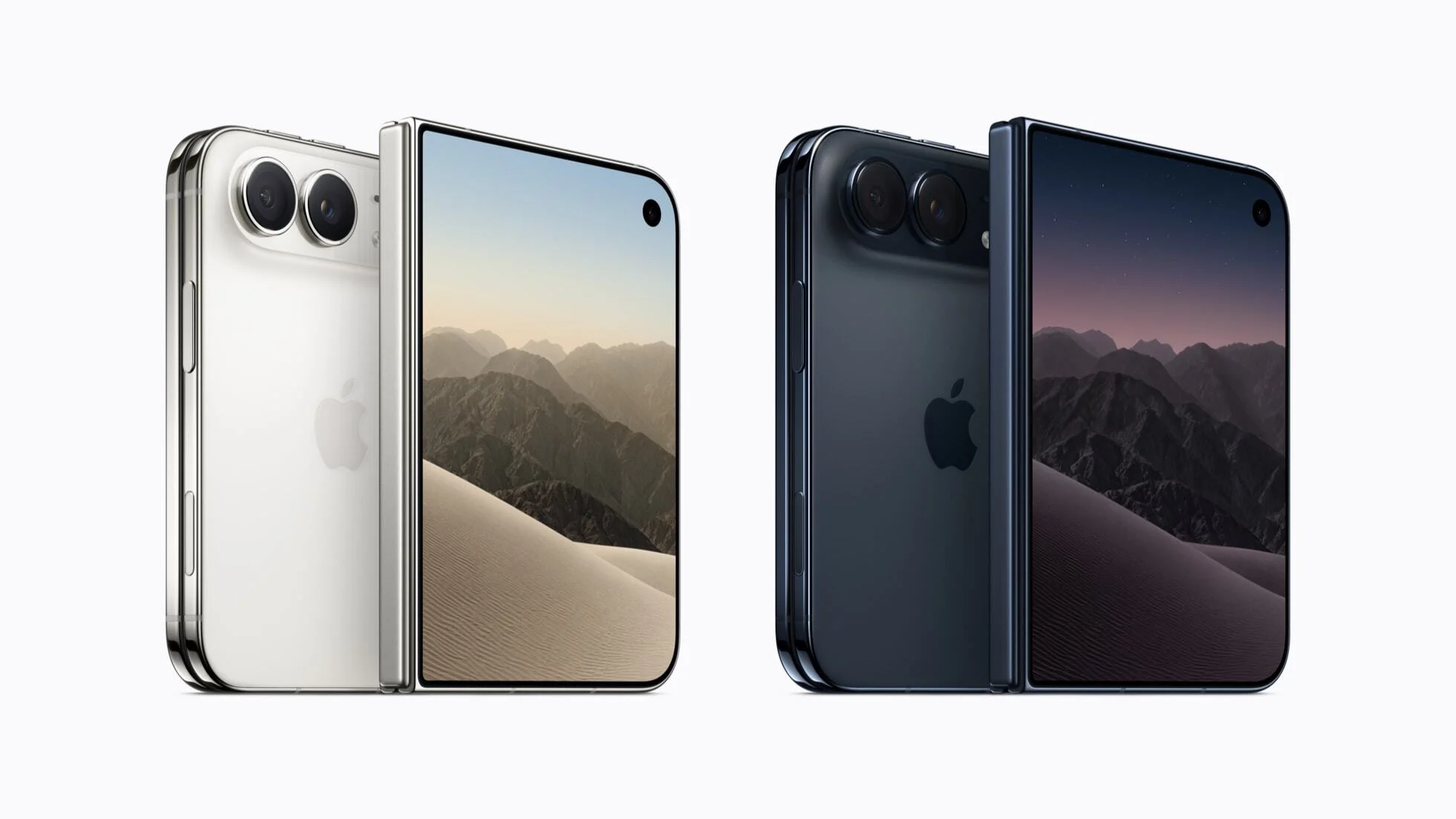
Apple announced the iPhone Duo on September 9, 2026. It’s the first iPhone that folds: closed it’s a 5.4-inch phone, open it’s a 7.6-inch small tablet. Pre-orders opened on October 16, and it’s in stores on Friday, October 23. I ordered one (1 TB in Star White) and I’m picking it up on launch day. Below you get every spec that matters, checked against Apple’s own pages, and what the phone means for a smart home with Apple Home, Matter or Home Assistant.
Quick explainer: N1, Thread and Matter
- N1 is Apple’s own wireless chip. In the iPhone Duo it handles Wi-Fi 7, Bluetooth 6 and Thread.
- Thread is a low-power radio network for smart home gadgets like sensors, buttons, plugs and door locks. The devices pass messages along to each other (a mesh), so the network gets stronger with every device you add.
- A Thread border router connects that mesh to your normal home network. In an Apple home that’s a HomePod mini, a HomePod (2nd generation) or an Apple TV 4K with Ethernet. Home Assistant can also be one if it has a Thread radio.
- Matter is the cross-brand smart home standard. A Matter device works with Apple Home, Google Home, Alexa and Home Assistant, and many Matter devices use Thread to talk.
iPhone Duo specs at a glance
| Outer display | 5.4 inches, OLED, 1398 × 2034 pixels, 460 ppi |
| Inner display | 7.6 inches, foldable OLED, 1878 × 2670 pixels, 430 ppi |
| Both displays | ProMotion up to 120 Hz, Always On, up to 3,000 nits outdoors |
| Chip | A20 Pro (same as iPhone 18 Pro), 6-core CPU, 7-core GPU |
| Rear cameras | 48MP Fusion Main and 48MP Fusion Ultra Wide, 2x telephoto via the main sensor (12MP) |
| Video | Up to 4K at 120 fps in Dolby Vision |
| Thickness | 5.2 mm open, 11.3 mm closed |
| Weight | 254 g (8.96 oz) |
| Battery | Up to 24 hours typical use, up to 44 hours video on the outer display, 31 hours on the inner display |
| Charging | About 50% in 20 minutes wired (60W adapter), MagSafe and Qi2 up to 25W |
| Wireless | N1 chip with Wi-Fi 7, Bluetooth 6 and Thread, C2 modem with 5G |
| SIM | eSIM only |
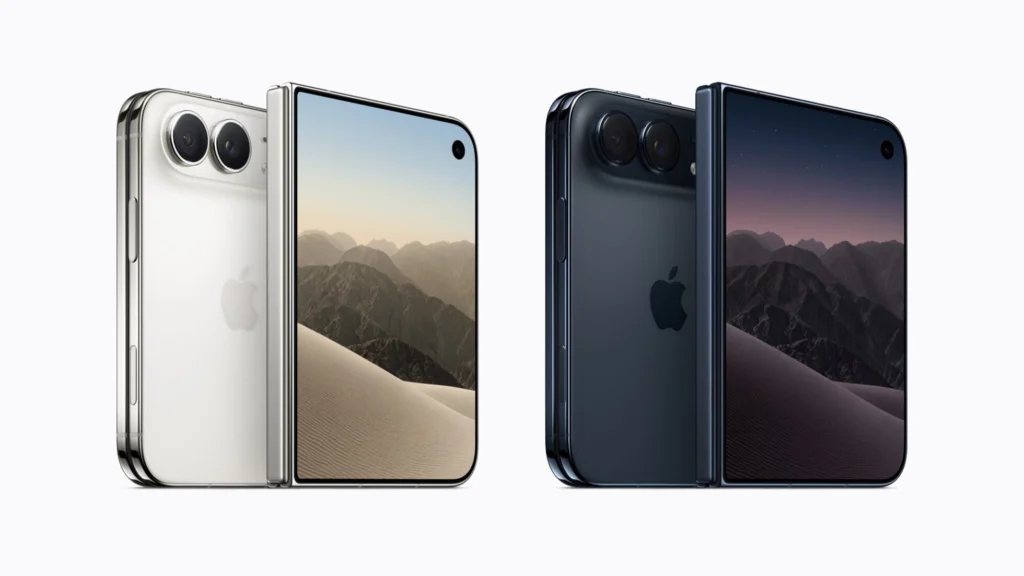
| Colors | Star White, Night Sky |
| Price (US) | $1,999 (256GB), $2,199 (512GB), $2,599 (1TB), $3,199 (2TB) |
| Release | Pre-order from October 16, in stores October 23 (US, UK, Canada, Germany, France and more), 28 more countries from October 30 |
What stands out in the specs
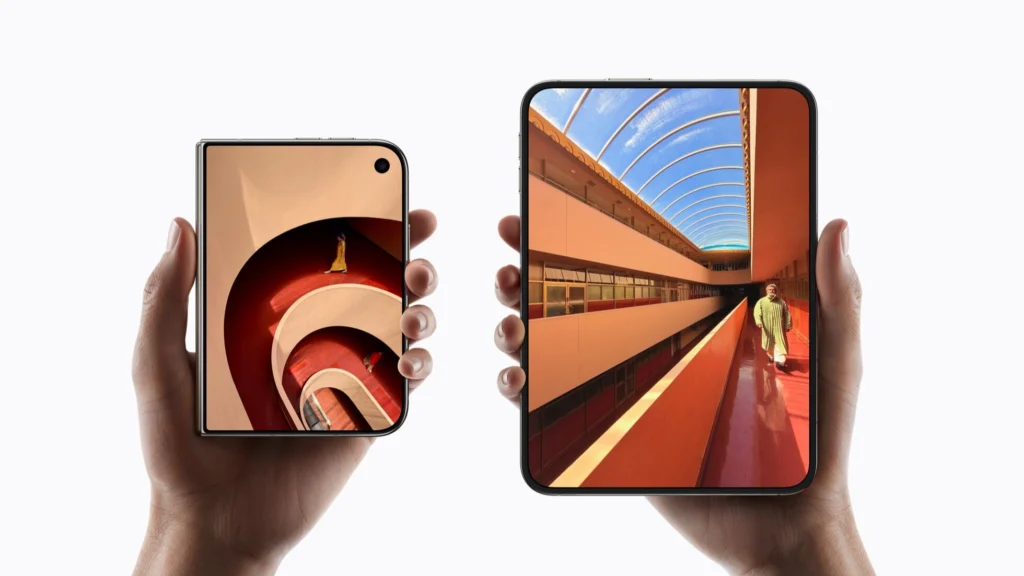
- Two screens: closed, the outer display has about 90% of the screen area of an iPhone 18 Pro, so it works as a normal phone. Open, the inner display is 50% larger than the one on the iPhone 18 Pro Max.
- Thin when open: Apple calls it the thinnest iPhone ever at 5.2 mm. Folded it’s 11.3 mm, and it weighs 254 g either way.
- Pro chip: the A20 Pro is the same chip as in the iPhone 18 Pro, so you’re not paying for a folding screen with a slower phone.
- Battery: Apple uses two batteries and quotes up to 24 hours when you use both displays equally.
The catch before you buy
- There’s no separate telephoto camera. The 2x zoom comes from the 48MP main sensor and gives you 12MP photos.
- eSIM only. The Duo doesn’t take a physical SIM card, so check that your carrier supports eSIM before you order.
- If you live in the EU: Apple says Siri AI won’t be available there at first on iOS.
- The price. $1,999 is the entry point with 256GB, and the 2TB model is $3,199.
What the N1 chip and Thread mean for your smart home
Thread on an iPhone isn’t brand new. The iPhone 17 models already have the N1 chip with Wi-Fi 7, Bluetooth 6 and Thread. If you have one of those, the Duo is not a smart home upgrade. If you’re coming from an older iPhone, it’s worth knowing what Thread on the phone actually does:
- Adding devices: when you add a Matter device that runs on Thread, the iPhone is the tool that brings it into your network. That’s the onboarding step, usually scanning the Matter QR code.
- It’s not a hub: the iPhone doesn’t keep your Thread network running and it’s not a border router. When you leave the house, your sensors and buttons keep working through your HomePod, Apple TV or Home Assistant, not the phone.
- Automations stay at home: automations in Apple Home run on the home hub (HomePod or Apple TV). In Home Assistant they run on your server. A new phone doesn’t change either of those.
iPhone Duo with Home Assistant, HomeKit and Matter
Apple doesn’t mention Home Assistant or Matter in the iPhone Duo announcement. The phone runs iOS like every other iPhone, though, so the usual ways to connect Home Assistant should work the same:
- Share Thread credentials: if Home Assistant runs its own Thread network (for example with a Connect ZBT-1 or ZBT-2), open the Home Assistant Companion app and go to Settings > Connectivity > Thread. There you can send Home Assistant’s network to your phone with “Send credentials to phone”, or send your Apple Thread network to Home Assistant. Without this step, Matter devices you add from the phone land in the phone’s preferred network, which might be your HomePod’s network instead of Home Assistant’s.
- Add Matter devices to Home Assistant: you add Matter devices to Home Assistant through the Companion app on your phone. On the Duo that should work exactly like on any other iPhone with Thread.
- Home Assistant devices in Apple Home: with the HomeKit Bridge in Home Assistant, Zigbee lights or sensors that Apple doesn’t know show up in the Home app on the Duo, and you can control them with Siri.
- Dashboard on the big screen: the 7.6-inch inner display is close to a small tablet. A Home Assistant dashboard built for tablets could be much more usable there than on a normal phone. Whether that works well is one of the things I’ll test.
If you don’t have Home Assistant yet, start with installing Home Assistant on Proxmox. And if you’re wondering about Apple’s new smart display, read Apple HomeView: what it does and why it’s not coming to the EU.
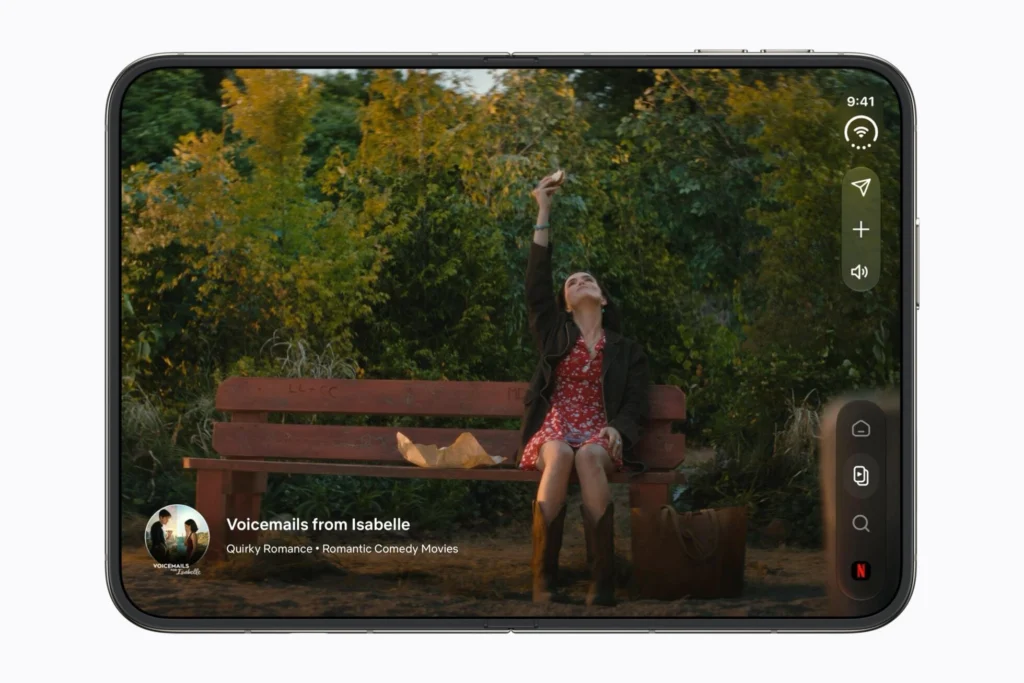
What I’ll test after pickup on October 23
I’m picking up my Duo on launch day and putting it straight into my smart home. These are the questions I want answered. I’ll add my results and my own photos here.
- Does adding a Matter device over Thread work as smoothly as on my current iPhone?
- Does “Send credentials to phone” in the Home Assistant Companion app work on the Duo, and do new Matter devices end up in Home Assistant’s Thread network?
- How does a Home Assistant dashboard look on the 7.6-inch inner display? Does the app use the tablet layout?
- How usable are the Home app and Home Assistant on the 5.4-inch outer display when the phone is closed?
- Do my HomeKit Bridge devices from Home Assistant show up and respond normally in the Home app?
Photos of my own Duo follow right after pickup.
Wrapping up
On paper the iPhone Duo is a full Pro iPhone that opens into a small tablet, at a price that starts at $1,999. For your smart home it brings Thread through the N1 chip, the same as the iPhone 17 models, so the bigger change is the 7.6-inch screen for dashboards and camera feeds. I’ll know more after October 23.
Sources: Apple Newsroom: Apple unveils iPhone Duo (September 9, 2026), Apple Newsroom on pre-orders, iPhone Duo tech specs, Apple Store prices, iPhone 17 tech specs and the Home Assistant Thread documentation.
Are you getting a Duo, or are you waiting for my test? Tell me in the comments.
Did this guide help you? You can buy me a coffee on Ko-fi. It keeps MappleBox ad-free.